DEMOCRATS OR CLOSET TYRANTS?
The midterm elections are virtually finished and save for those in the edges, we already know the winners. It’s a complete rout for the opposition! The gnashing of teeth you could almost hear, the seething outrage and bitterness, the weeping and the sobbing, the curses. Of course, the sweeping loss was not really unexpected. Surveys consistently showed them outside the winning circle until election day. But hope was pinned on the faith that the electorate was essentially ‘intelligent’ and will come to its senses come D-day. Well, hope was gravely misplaced as it turned out. Now, the bellowing we hear: “It’s the end of Democracy!” “The Dark Days are here!” “It’s the triumph of Evil!” “The people are just stupid!”
Now, if you are familiar with the opposition, they are the loudest, most vociferous champions of Democracy. To them Democracy is like some sacred item that must be guarded, treasured, revered, sanctified. The slightest hint of it being touched, disrespected or defiled is certain to raise a howl of protest from among their ranks. So why the pronouncements of gloom and doom after a relatively peaceful and credible elections? They reveal their true selves.
Democracy is the rule of the people— this is the fundamental concept. Accordingly, the people get to choose their rulers, leaders, or representatives by way of exercises called elections. In these exercises, winners are determined by the Rule of Majority— how else? Democracy therefore is essentially the Rule of Majority. So, how, may I ask, could a true advocate of Democracy mock the Majority when it is the essential representation of the will of the people? Indeed, mocking and assailing the Majority do not go well with exalting Democracy because the view that the masses are foolish and unenlightened is the very same argument against Democracy!
The opposition should resolve if they really are for Democracy or if they are not in fact closet tyrants. Democracy by necessity demands openness and tolerance to differing, contrary opinions. Intolerance is bigotry— which is more in agreement with tyranny. You could excuse bigotry in bigots, but in people claiming to champion Democracy…?
DEMOCRACY ON THE BRINK?
Voting day today. I cast my vote an hour ago. Two days before, someone I know came to inquire if I wanted my share of the booty being spread around. I said, no, thank you, you can have it; so thankful he was. I know the guy needed it more; and I wanted to feel holy hahaha, so it was not really charity. Local bets were paying around two thousand to three thousand per voter, I heard. Where I am, that would translate to about P70M to P100M less of the candidates’ wealth— to be replenished by whatever means in the future, of course. At first, it was surreptitious. In the last of days, there was no hiding it anymore, queues of people out in the open all happily lining up for their envelopes. The cops were helpless, they just pretended not to see. It seems like the people have come to find this par for the course now, their votes being bid out in auction blocks to the highest bidder now a legitimate part of the business of elections. Did the inventors of Democracy foresee this phenomenon?
Interestingly, Plato, the wise man, disliked Democracy. His reason, Democracy inevitably leads to a “rapid influx of freedom” and having tasted freedom people will “become drunk off it, …people will demand freedom at every turn, fighting any form of authority and demanding more liberty… become obsessed with… freedom… willing to sacrifice necessary things like social order and structure to attain it.” He seems prophetically accurate.
Its devotees, however, put Democracy in an altar, like some Divine Creation which must be worshiped and held in highest deference at all times, anything at all impeding or disturbing its purity an anathema of the highest order. Freedom forms its core ideal. Ironically though, why do we find these devotees often sneering at or putting down the very results of the processes that constitute Democracy? Dismayed at the cast of characters that have come to dominate democratic elections, we find them often railing at the “ignorance” and “stupidity” of the masses that voted them into office. Yet, should it come unexpected like some eye-popping anomaly? Democracy after all upholds the rule of majority or plurality. And most of the people are really not the wise and bright ones, the mature, rational, responsible, and patriotic. Bluntly put, the majority that rules in a Democracy are, well, the “unintelligent”, “unenlightened” ones. But even so, as Democracy advocates, should they not have more faith on the “voice of the people” as being “the voice of GOD”?
Indeed, for all its deleterious defects, Democracy wins out because it works and so far we have not been able to devise a system that is better and as workable. Plato, for all his wisdom, had in fact put forth an alternative, one embracing all the good and magnificent in a government— except that it seems impractical, only good in theory. Democracy’s strength actually lies in its legitimizing power anchored on the numerical superiority of the acceding majority. As far as choosing the rulers is concerned, the majority rule gets near-universal acceptance. This power lends clear political mandate to elected officials that in turn lends political stability without resort to tyranny and oppression.
It suffers of course in the quality of decision because the masses in general are deficient as they are. But the masses could wise up fast, grow more mature, intelligent and responsible for Democracy to survive. This growing tradition of selling ones vote to the highest bidder would never help Democracy flourish onward. The alternative if it fails is for the un-elected—un-elected because they could not win elections— wise men and women to take power and preside. But lacking in proper mandate to wield power over the people, hence no political legitimacy, oppression and tyranny would be the only resort.
DENGVAXIA & THE MATHEMATICS OF PNOY
“Bibigyang-diin ko po: 17 lang sa kabuuang bilang na 837,902 ng nabakunahan ang BAKA magkaroon ng … Severe Dengue.” (I wish to stress: only 17 out of the total 837,902 vaccinated are PERHAPS in danger of contracting… Severe Dengue.)
In his official statement posted on his Facebook account regarding the Dengvaxia scandal, this is essentially how former President Noynoy Aquino is defending his approval of the mass vaccination of children in 2016 with the anti-dengue vaccine: the risk was infinitely small, comparably, the benefits infinitely more enormous.
How he got his figure, 17, however, is one curiosity. On the seventh paragraph, the former President is clearly out to mesmerize with his mathematical genius.
Suriin natin kung gaano karami ang sinasabing baka may risko. Hinihimok ko kayong gumamit ng calculator. Batay sa records, may kabuuang bilang na 837,902 ng taong nakatangap ng kahit isang dose ng Dengvaxia. Tinataya na 90% daw ng katao sa bansa ang na-expose na sa Dengue. Ang tinatayang hindi pa nagka-Dengue ay 10% naman. Ang sabi: .02% ng naturang 10% ang may riskong magkaroon ng Severe Dengue. Paano tinatala ang .02%? Sa calculator, ito ay: .0002 o 2 kada 10,000. Para ma-compute ngayon ang .02% ay kunin ang 10% ng 837,902. Ito ay 83,790.2, saka i-divide ito sa 10,000; tapos ay i-multiply sa 2. Ang resulta ay: 16.758, o pag-rounded off ay 17. Bibigyang-diin ko po: 17 lang sa kabuuang bilang na 837,902 ng nabakunahan ang BAKA magkaroon ng Grade I at II na Severe Dengue. Ipunto ko na rin po, na sa kabilang panig naman: 837,902 na katao ang magbebenepisyo sa dagdag na proteksyon ng bakuna.
Translation:
Let us examine how many are probably at risk as being alleged. I enjoin you to use a calculator. Based on record, a total number of 837,902 of individuals has received at least one dose of Dengvaxia. It is estimated that 90% of the nation’s population is already exposed to Dengue. An estimated 10% has yet to contract Dengue. It is said: .02% of the aforementioned 10% has a risk of getting Severe Dengue. How is .02% denoted? On a calculator, this is: .0002 or 2 per 10,000. Now to compute for the .02%, get the 10% of 837,902. This is 83,790.2, then divide this by 10,000; afterwards multiply with 2. The result: 16.758, or rounded off, 17. I wish to stress: only 17 out of the total 837,902 vaccinated are PERHAPS in danger of contracting Grade I and II Severe Dengue. On the other hand, I wish to point out: 837,902 persons benefit from added protection of the vaccine. (emphasis mine)
(Well, Mr. President, if a calculator is at hand, this is much quicker: 837,902 x 10%= ans. x .02%.)
But, wait… where did these figures come from?: “90% ng katao sa bansa” ( I translated as 90% of the nation’s population) and “.02% ng naturang 10%” (.02% of aforementioned 10%). Okay, the latter is probably supplied by Sanofi-Pasteur, the drug manufacturer, though, I do not recall any such assertion made. But the 90%—where did the former President pluck that out? Because, unless I mistranslated, it is in effect claiming that 90% of 105 million Filipinos, most recent estimate of total Philippine population, or 94,500,000, is already exposed to dengue! Meaning, there has been a yearly average of 1,890,000 dengue victims in the Philippines— for the past 50 years! Now, that’s just outlandish.
The former President should revisit his statement. Extrapolating that only 17 out of the more than 837,902 vaccinated are in real danger is—besides being dumb— spectacularly outrageous. If he thinks he made a good impression with his mathematics, he is seriously mistaken. Where did he get the 90%?
I AM A SPAMMER?!
If it is their latest innovation to block or limit unwanted posts, or simply a technical glitch— I don’t know. But my posts on Inquirer’s discussion forum today have been tagged as spam. All five of them consecutively on this article.
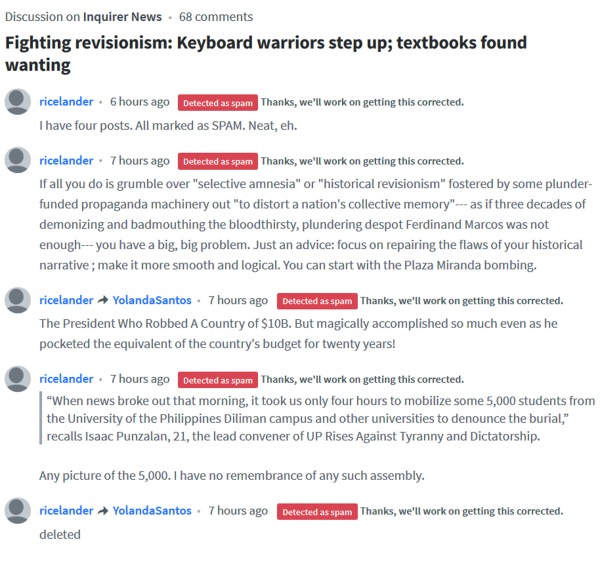 This is new. Usually, all I get is a notice of moderation and a tag on my comment as pending. At Inquirer, about 10% of my comments gets that much attention. By experience though, when you get that, it is good as blocked, later removed without any explanation. This spam-tagging will probably go the same way. What is surprising this time is ALL of my comments were summarily blocked. Interestingly, I do not encounter the same problem with other online newspapers using Disqus.
CONVICTING IMELDA
The Marcos haters are jumping in ecstasy. The Sandiganbayan has convicted Imelda Marcos of graft and she could be facing arrest any hour or day now. At long last, a conviction. After decades of prosecution, more than nine hundred cases all in all, finally, a stake at which to burn Imelda. The sight of the once mighty and powerful First Lady being handcuffed, mugshots of her taken and plastered on all media are certain to give them orgasmic pleasure beyond compare (never mind that it could just be a house arrest given her age, or the decision could yet be reversed by the Supreme Court).
Victory for truth and justice! they cry in righteous euphoria; victory too against historical revisionism! To them, this is a roaring, unmitigated affirmation of the Marcos’ sheer wickedness as a family, a verdict long made which they have been working long and hard to sway the people to, but in vain. In vain no more, they must reckon now.
Is it really a victory?
The problem with the decision, as with all other allegations against Imelda and Ferdinand Marcos as regards their supposed ill-gotten wealth, is it remains anchored on the same one and only contention made since the beginning: the billions of the Marcos family could not have come from their salaries; therefore it must have been stolen from the government treasury! Interestingly so, even the Supreme Court decision which affirmed the ill-gotten nature of the Marcos wealth was in essence argued along the same, old line. Reading the Sandiganbayan decision, this appears to be the implicit premise around which the Sandiganbayan justices built their arguments, on the issue of the foundations in question, in convicting Imelda: these were massive amounts of money stolen from the government— Imelda and Ferdinand were hiding and funneling these using the foundations.
But back to this line: the billions of the Marcos family could not have come from their salaries; therefore it must have been stolen from the government treasury! On closer look and soberly, no high IQ needed, this assertion is obviously infirm. Need I explain? No matter, as propaganda line, it has staying power and clinging lethality at maligning its subjects. Failing though to perfect the allegation with more compelling evidence—like, showing and identifying the sources of such colossal plunder, $10B, more or less the equivalent of the entire national budget for twenty years, and detailing how such a feat could have been accomplished, without any audit trail at that — it had lost most of its poisonous sting over the years. Accordingly, adherents have dwindled, but for the loud, persistent, hardcore haters yet soldiering on. Are they hoping that with Imelda’s conviction, their propaganda line would yet regain its lethal power and slay Imelda this time, once and for all? Unlikely, I think. For one, you could sense something’s kinda wobbly somewhere when the justices are themselves seemingly saying, “well, we are not absolutely certain, only morally certain…”. Let’s see if daughter Imee’s numbers would get affected.
But Imelda might want to seize the day, or go for broke, in one final act to clear her name and her entire family’s beyond any doubt. On Youtube and other social media, videos abound showing her explaining the source of her family’s wealth, a roomful of stacks and rows of documents supposedly attesting to her husband’s immense wealth serving as a backdrop. The most curious part is where she invites a few select people to take a peek at supposed gold certificates worth billions of dollars and bills of lading for some gold shipments. Are these for real?! If these are— and I suppose, incredible as it may seem, there must be some truth to it,— this might well be the opportunity she has been waiting for, her moment of sweet revenge to shame and silence them all accusers aside. She could haul off all those documents to the Supreme Court, present these as her defense and request for judicial determination of their authenticity and genuineness. It would be one dramatic spectacle to behold, fit for her final act, her witness and audience this time, the entire nation itself, and even the world. But, the big question is, of course, are the documents real? You could almost hear her haters’ sneer from a mile away.
HEY, ENRILE, SOMEONE HAS ACCEPTED YOUR DARE!
Finally, someone has accepted Juan Ponce Enrile’s challenge to an open public debate. It’s Philippine Star columnist Jarius Bandoc.
I say, get it on.
BBM & JPE: An Interview
Bongbong Marcos interviews his father’s Defense Minister, Juan Ponce Enrile.
One could almost hear the screaming: Revisionism! Revisionism!
But there’s one shocking revelation made by Enrile. One of the reasons for the declaration of Martial law, he claims, was the forging of a formal alliance between the Liberal Party and the Communist Party of the Philippines.
By the way, we are still awaiting for someone from the anti-Marcos forces to finally accept Enrile’s long-standing challenge to a public debate, a dare he reiterated in the interview..
There’s a part 2.
WHAT? JOMA SISON IS HUMAN RIGHTS VIOLATIONS VICTIM!?
JOMA SISON, WIFE GET P2.4M IN MARTIAL LAW COMPENSATION!
No kidding, the brains behind the Plaza Miranda bombing and former Chairman of the Communist Party of the Philippines who led a violent rebellion to transform the Philippines into a communist state, resulting in tens of thousands deaths and other immeasurable destruction, the same man tagged as terrorist by the US several years ago, is getting compensation as, hold your breath, a “victim” of Martial law. (And wife too.) Just incredible!
To be honest, I saw this coming. But I was also half-expecting that Joma will waive his claim, out of a sense of nobility, ahem. I was wrong, of course.
So, here is a lesson on how lies, when upheld as truth, eventually transmogrify into one colossal farce, like Joma, the terrorist, being recognized as human rights victims with more than a million pesos for a reward hahaha!
The lies: 1) President Marcos masterminded the Plaza Miranda bombing to pave the way for dictatorship 2) the MV Karagatan was a hoax 3) the communist threat was not real 4) the communist movement came into being as a consequence of Marcos’ repressive and tyrannical rule 5) those who fought Marcos were freedom fighters not communists.
To be sure, his bonanza was a consequence of an earlier case filed against the Marcoses in Hawaii by a supposed group of “ten thousand victims of Marcos” which it eventually won, being granted a humongous compensation of more than $2B for damages supposedly as human rights victims of Marcos. In reality, this group was composed mostly of members of the underground communist movement which, of course, included Joma Sison, the head of the movement, and his wife. After Marcos’ fall from power, true to form they saw an opportunity to avenge their defeat in the battlefield and likewise make money out of it by recasting themselves as human rights victims. It worked; they won big time. Emboldened by this huge legal victory and financial windfall in Hawaii, the same group through its elected partylist representatives in Congress soon had a counterpart bill seeking to indemnify and recognize all supposed victims of President Marcos. Expectedly, the old enemies of Marcos in the mainstream gave support. There in that bill, which soon became RA 10368 , conveniently tucked a rider provision recognizing the Hawaii group as automatic beneficiaries of the law. Neat.
Looking for an opportunity to paint Ferdinand Marcos in a bad light at a time when the Marcos name was becoming resurgent and then-Senator Bongbong Marcos was hinting to run for higher office, President Benigno Aquino III lost no time to sign the law in 2013. As expected, he took the occasion to remind the Filipinos of the heroism of those who fought Marcos, the monster responsible for all the destruction and havoc that visited the Philippines.
Indeed, who among Filipinos actually knows that Joma Sison and wife are jointly receiving P2.4M as human rights victims of Martial law? Not many. In fact, that most claimants were leftists/communists and among them is their former topmost leader has been deliberately downplayed or concealed from the public. It’s understandable. Like it or not, Joma Sison as human rights compensation recipient is sure to raise many eyebrows. What more, by implication, some of the most treasured anti-Marcos narratives of recent history get unwittingly jeopardized. At a time when the anti-Marcos forces are too busy fending off supposed attempts of Marcos loyalists and the Marcos propaganda machine to revise history and rebuild the name they most despise, this news should just have been better buried unseen.
EDSA PEOPLE POWER
The EDSA 86 People Power celebration has come and gone uneventfully as usual. The celebratory mood is gone for good, no doubt; well, for all intents and purposes, it was, since many years ago. But many understandably still remain nostalgic of the four-day event. After all, it was then regarded as one of the highest points and proudest moments of the Philippines as a nation and the Filipinos as a people. That the world even stood up in applause and in awe was truly something. EDSA was undeniably a grand spectacle, a sight to behold, a sea of people as far as one could see, hundreds of thousands of them or probably millions; it was people power in all its majesty. So, how such a monumental event which forced the dictator, President Ferdinand Marcos, out of office in disgrace could ever lose its meaning and relevance to present-day Filipinos, it baffles them much. Worse, not only is the festiveness gone, an atmosphere of meaninglessness seems to have replaced it since. Last year, the crowd was so sparse and lifeless, (until, of course, Jim Paredes took center stage) it could be even sparser and more lifeless this year. It is merely all a matter of compulsion now, to serve a historical narrative, or so it feels.
How did it come to this? The Yellows, the torchbearer of the EDSA narrative, of course, are mostly blaming “revisionism” supposedly being funded by the Marcos’ plundered billions. How so-called revisionism could flip over so swiftly a narrative created and nurtured since 1986, with all the aid of government, mass media, educational system, and all combined anti-Marcos forces, is, however, curious. Such a wide, wide head start, all of three decades, gone in no time at all?
The EDSA narrative in broad strokes could be summarized like this:
Once upon a time, an evil villain, Ferdinand Marcos, came to rule the land, the Philippines. After being President for eight long years plundering the treasury of the land, he craved for much more. So, he declared Martial law near the end of his term to hold on to power and be able to ransack the treasury for more years to come, his alibi, the communist insurgency problem. He then turned himself into a dictator and presided over the Dark Years of Martial law. From these dark years of cruel repression and insatiable greed emerged a hero, Benigno “Ninoy” Aquino Jr. The brave hero, Ninoy, led the fight against Marcos, who by then had teamed up with his wife, Imelda, who was just as wicked. To stop Ninoy, the evil duo had him jailed on trumped up charges. In jail, however, Ninoy could still not be cowed and silenced. Thus, Ferdinand and Imelda, exiled him to America. After sometime, Ninoy realized that he could not turn his back on his people. Undaunted by the wrath of Marcos and Imelda, he decided to return to his land to free his people from repression and heinous rule. On his return, on orders of Marcos, Ninoy was shot dead by his escort soldiers, in a brazen display of wickedness, right upon his arrival, in broad daylight, right at the airport tarmac. It came to be the start of the regime’s downfall. Millions attended the funeral to hail Ninoy and show their anger on Marcos. Soon after, massive protest rallies became regular fare. Marcos, to appease growing discontent, before long announced a snap election to prove that he had the support of the Filipinos. He met his challenger in the hero’s wife, Cory. All the good Filipinos rallied around her to defeat Marcos and his minions. Cory won the election despite massive cheating but Marcos would not concede and vacate office. Thus, the people, drawing inspiration from Ninoy’s brutal death in the hands of Marcos, protested for days on end. Protests grew and grew until finally it culminated in millions of people converging for days at EDSA to demand the ouster of the evil leader. Marcos got so scared of his own people, he packed up in a hurry and escaped with his family to Hawaii. And the Filipinos, after years of brutal repression, finally regained their long-lost freedom, thanks to the great courage of Ninoy and Cory.
This is the EDSA narrative, the fount of inspiration for the yearly celebration. Could anyone find a better real life good-versus-evil story, the good triumphing in the end and the bad guy scampering away in fear, tail between his legs? EDSA 86 was thus altogether celebrated as the triumph of good over evil, of Ninoy and Cory over Marcos, of freedom over repression, of democracy over dictatorship, of the Filipino people over the corrupt government…. Ahh, such a picture perfect narrative.
Until this alternative version began taking shape:
No, Marcos was not the evil ruler he was painted to be. In fact he was a good ruler, even perhaps the greatest President the Philippines ever had. He declared Martial law in 1972 and assumed dictatorial powers to contain a fast-growing communist movement and to implement sweeping changes. He presided over a massive infrastructure development program and pressed for far-reaching economic and political reforms, many painful. In so doing, he created many enemies. Benigno ‘Ninoy’ Aquino, his main political nemesis, was jailed for conniving with and supporting the communists to oust the government. It was his dream to be President after Marcos. After several years in prison, he was allowed out of jail for medical treatment of a heart problem in America. While there, he rekindled his opposition to Marcos. Learning that Marcos was in serious medical condition, he came back to the Philippines. At the airport, he was shot and killed by a lone gunman. Many people were convinced that Marcos was the mastermind. But he was not; Marcos had in fact been seriously ill all that time. Ensuing social unrest due to the murder forced him to hold elections. Cory, Ninoy’s wife, ran against him. Marcos won by a small margin but the opposition charged election cheating. Massive protests and boycotts funded by his enemies were launched soon after. Two of his most trusted men, Juan Ponce Enrile and General Fidel Ramos, traitors both, later launched a mutiny. Cory and various forces aligned with the opposition quickly joined them. EDSA filled up with hundreds of thousands of people. More of the state forces defected. To avoid bloodshed, Marcos decided to leave Malacañang and head north to home province Ilocos Norte. But he was flown out on a helicopter to Hawaii instead.
There. Which version is true? As in any event, there are always two sides–or even several– sides of the story. Right now there are just two main contending perspectives: the victors’ EDSA version and the losing side’s version. Sometime in the future, when a younger, dispassionate set of historians gets down to write this part of history, perhaps they would be reconciled. Right now, that looks impossible. As it is, those championing the original narrative are so infuriated that the latter conflicting version, for some reason, is gaining more traction. They lay the blame on a curious mix of culprits: a supposed well-funded Marcos propaganda machine trying to revise the past, gullible youths who can’t differentiate truth from fake news, apathetic parents for not guiding their children to the right information, negligent educators for not teaching correct history, paid trolls on social media for not knowing any better, the people themselves for historical amnesia, and so on and so forth. They are not taking this sitting down. They are presently racing to erect museums, hold as many talks and forums as possible, write as many books, make as many films and documentaries, compose songs, create comics, art, theater plays, all in defense of their narrative. They are all over the media too bashing any and all contrarians. Well, truth is its own defense, don’t they say?
But, really now, the first narrative needs improvement. There is, for instance, one fatal fault that badly needs fixing, if it could be fixed at all. It lies in the assassination.
As an integral piece of the narrative, the murder of Ninoy in the hands of an assassin on orders of Marcos is a key part. It is, in fact, central to the story. It gives climax to Ninoy’s greatness, his death in the hands of his archenemy the completion of his heroism. Correspondingly, it highlights Marcos’ utter depravity, Ninoy’s murder on his orders the pits of his villainy. At the same time, as it is the real trigger to Marcos’ downfall, when everything starts collapsing under his feet, finally culminating in the EDSA People Power Revolt, this episode is truly integral. It must thus stay intact.
Problem is, damn it, it looks like Marcos was really innocent! All these years and nothing at all to show for proof? Indeed, of all the cocksure, angry accusers, not one it seems is left standing still confidently pointing to Marcos as the main man to hang. They all have stopped at some point. Even the Aquinos. Well, except in some roundabout way: “he (Marcos) created the conditions for it to happen”, in the words of Noynoy, the victim’s son.
Now, if he was not the mastermind,what do we make of Ninoy’s death? And to a larger extent, because his murder precipitated it, of EDSA People Power? Like it or not, the whole drama rises—or falls— on the fierce and bitter rivalry between Ninoy and Marcos, its climax being the assassination of Ninoy with Marcos as the mastermind. The waves of upheavals that follow, cresting one last time as the EDSA uprising, are all composite part of it. If Marcos is not the mastermind, the entire story crashes down! If this were fiction, it is poor, shoddy writing. Imagine that the real instigator were, say, the CIA, or Danding Cojuangco, as some people were alleging. Or, just some nut.
Defenders of the narrative assert that it does not matter who killed Ninoy; what is important, they contend, is that Ninoy’s death resulted in the overthrow of Marcos and the return of democracy. Really? On the contrary, it matters a whole lot. See, a narrative must be smooth, authentic, intelligible, and believable, not one tangled in some incoherent, disjointed, impossible flow of causation and events. The latter kind is sure to get rejected and abandoned. If Marcos was not it, what does one make of the story, indeed? For example, there were broad hints that Ninoy was intently killed to create unrest and through it force Marcos out of power and restore democracy. Or, that Ninoy was bumped off for some other reasons, but everything took totally unexpected, if favorable, turns. Surely, any such alternate scenario will force a radical revision of the story line, the narrative will have to be rewritten.
Of course, if Marcos was truly innocent, the implications are eminently damning. It means that he was all along a victim of wrong accusations, that all the rage and condemnation, all that fire and brimstone, fiercely rained on him by his accusers as the murderer, were gravely undeserved. This is the part that his enemies would certainly want to gloss over forever. It could likely be the reason too why the wife and the son of the victim, Cory and Noynoy, who both became Presidents, never lifted a finger despite the clamor to initiate a re-investigation of the case to find out who really was the brains. It surely serves the narrative better to at least preserve the doubt than remove it all. Remove it all and Marcos becomes the martyr! It must be haunting them too. It is axiomatic that wrong accusations ultimately damn the accuser and exalt the accused.
So, what do we make of EDSA and the millions that gathered there? The biggest assembly ever of the dazed and confused?
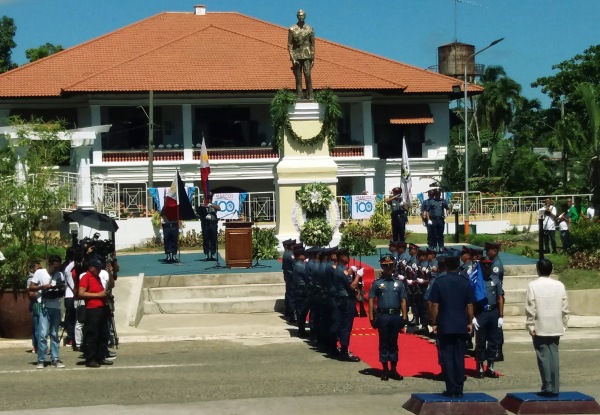
MAKOY, 100
DRUGS, DUE PROCESS & EJKs
More than a week ago, President Rodrigo Duterte made the admission that he gravely underestimated the problem on drugs. No, he said finally with a tone of resignation, he will not be able to solve the problem in a few months as he promised, nor even in his entire term. From the start, I was quite certain he will fail. But even so, I gave him the benefit of doubt. Mine was all theory, after all; and theories being theories, they could be wrong.
The theory is simple, really. The Law of Supply and Demand tells us that drug prohibition limits distribution alright, but, and this is crucial, it also jacks up the market price of the product sky-scraping high. What otherwise is a cheap commodity sold freely gets to be sold to, if relatively small, a reliable market of do-or-die drug users and addicts willing to pay at any price. With profit margins so wide, it makes for an ultra-lucrative money-making business certain to draw the greed of man. And it being an illegal product, business burrows deep underground, well into the hands of a cabal of men whose qualities belong there— crooks, criminals, outlaws— wanting a piece of the action. In short, prohibition actually, if inadvertently, creates a wellspring of abundant riches flowing into the wrong hands.
“…abundant riches flowing into the wrong hands”— this should very well be the focal point of attention. Unfortunately, this is always lost in the drug debate. When the crooks and wicked ones get that easy access to abundant resources to use and dispense, beware, society is in peril.
A drug lord’s detrimental influence on society should be instructive enough by now. From his millions of daily earnings alone, how much, we could only speculate, goes precisely to procuring, silencing, neutralizing or eliminating every component of the so-called due process: witnesses, law enforcers and state agents, lawyers, fiscals and judges, media, even entire communities, people of influence, and so on an so forth. It goes with the business. If his trade should survive, let alone prosper, illegal as it is, he must sway the system to his side, by hook or by crook, no ifs, no buts. Justice system and its foundations effectively corrupted, he gets control of due process. In fact, every time the critics of Duterte’s brutal war on drugs go screaming “due process!” I could imagine a drug lord’s wide and satisfied grin on his face. “Due process, indeed!” he might as well be muttering too in chorus. They are in agreement!
Yet, about due process, who could argue with the critics? Due process is a well founded concept in any civil society. You do not go merrily chasing and killing suspects on the pretext that these people are a menace to society. That’s for barbarians. We live in the modern world where there is due process to observe at all times, if we even consider our society part of it. There is human rights to respect. There is a presumption of innocence accorded every suspect. All these and more rest on deep-rooted principles long before established by the collective wisdom of modern humanity tracing back from the period of Enlightenment and the great minds of ancient times. In the modern world, it has long served as one of its solid foundations.
But the world is turned upside down. System thoroughly corrupted, strange alliances you find. Is there anything more odd than finding drug syndicates on the same side with human rights advocates, lawyers groups , civil society members, academicians, libertarians, religious groups, etc.? Even the world leaders and the UN agents who at once joined the uproar against the President’s brutal war must have gotten some applause from the drug lords. In fact, to escape attention, the latter could vanish in the shadows in the meantime and leave the fighting to their accidental allies. When the smoke of the battle clears up, it’s back to business, a more hospitable atmosphere in place through the effort not theirs but of the ardent due process campaigners.
The President understands it so well, even if he does not admit it openly, that the system is now compromised, rendered helpless by the power of the drug syndicates over the system. Drug lords are running rings around law enforcers and the justice system. Big-time offenders caught in elaborate and costly trapping operations marching out to their freedom so fast, is source of frustration, but nothing he can do about it. Due process, corrupted as it is by the drug syndicates, is tilted in their favor. To him and his kind, there is only one option left to save society from them: hunt them bastards down and eliminate them one by one with extreme prejudice pronto— due process be damned, Davao City style. Extra judicial killing, they call it. Or vigilantism.
And he appeared to be succeeding. There was strong mass support, with the public terrified of escalating crimes so gory and vicious somehow linked to the drug problem. Tacit approval was granted perhaps confident that it is the bad guys who are being hunted and eliminated. These were justified killings, they deserved it, or so they held. Two mayors and thousands of dead later, the public kept its peace, save for the usual noisy critics. It must have helped that the people highly trust the President.
Then came Kian de los Santos. After his killing, the public mood has changed so drastically, you can feel it. The campaign has taken a bad turn. A young boy at seventeen from a poor family, a student, he was ostensibly moonlighting on the side running drugs. Petty connection with drugs notwithstanding, Kian is not your poster boy of villainy, but rather of innocence forced into the pit by the circumstances of his young life. You do not kill their kind. You take them under your care to be steered to a better direction. Young as he is, he could yet be saved. But he is dead now, apparently executed by overeager, trigger-happy agents of the law inspired, or perhaps confused, by the President’s repeated expressions of rage and fierce messaging against drug traffickers.
With Kian, suddenly society is confronted with the appalling brutality of such a war. Shocked and collective conscience pricked, the public is forced to ask, just how many killings still must be perpetrated to defeat the scourge? Ten thousand? Twenty? Thirty…. a hundred thousand more? Suddenly, the people are asking themselves, can we still stomach this kind of violence? No doubt, Duterte’s war on drugs has suffered a fatal hit. Another Kian, Duterte’s political fortunes could start to take a fatal reverse. As expected, the political opposition is milking the tragedy dry for all its worth hoping perhaps it will lead to his downfall. As in any war, collateral damage, like Kian, is unavoidable. As collateral damage piles up, expect resistance to grow and grow until he is forced to stop. I remember former Columbian President Cesar Gaviria who earlier attempted to counsel Duterte about the war on drugs for he too went along the same pathway. If he took a pause and listened to him instead of launching a hail of curses, Duterte would have profited from a good advice instead. But that is all water under the bridge now.
Then too, there’s that P6B drug smuggling caper a few weeks ago. The President must have been stumped, red-faced. It is the biggest haul so far in the history of drug enforcement in the country. That it transpired right smack into the country’s main port of entry is saying a lot. Wonder if it is not really meant to mock the President and so send home the message: no you can’t, idiot!
It is a dilemma really. We are dealing with drug users who think nothing wrong of their vice and drug suppliers who think nothing wrong about supplying their costumer. Indeed, if we come right down to it , what intrinsic wrong could be attributed to the act of using drugs for which a user must be severely punished? By extension, what inherent wrong does a seller commit in selling that product to his eager buyer that he must go prison for life or die? Truthfully, none. So why should they be getting the same punishment as does a murderer or a rapist?
Society of course sees things from a different perspective. It sees drugs as destructive to society. Drug use make people commit atrocious crimes. Drugs destroy the human mind. And so and and so forth. And so it must act to protect itself by prohibiting drug use and drug trafficking. If death must be meted, so be it, if the greater interest of the whole society depended on it.
It’s a total clash of perspective and interest . And somewhere sometime, something’s gotta give.
As it happens, market forces prevail by the weight of their own laws. To illustrate, the tighter and stricter the prohibition is, the riskier the business, and tighter too becomes the supply. The tighter the supply, where buyers pay at any price, the more profitable is the business. Imagine a grain of shabu selling at the price of a grain of gold and you can imagine a drug lord getting richer even more, richer and more powerful than ever.
There is no winning this war. The earlier we come to terms with this, the better.
LISTEN TO THIS BOY GENIUS
DUTERTE AND THE LASCAÑAS AFFAIR
I’ve spent perhaps at least an hour watching those Youtube streaming videos on the Lascañas testimony on the Senate hearing. If any bombshell was detonated, I did not notice or probably I missed. All in all, the ‘show’ did not appear to have lived up to the expectation of the sponsors.
What took most of the blast away it seems was the impression that it was all staged to destabilize the new government, or at least shave off from its popularity. From where I sat, there was utter lack of authenticity in the claim that Arthur Lascañas had a recent bout with his conscience leading to a so-called spiritual renewal hence the new revelations and the recantation of an earlier testimony made just a few months before in the same venue. Now, if there was any truth in his revelations, they were surely drowned by suspicions of ulterior motive and machinations of vested interest. After all, it was pretty undisguised where all the reinforcement was coming from. For all their protestations that they were not villains out to destabilize the government, the Yellows, like wolves in sheep’s clothing, unmistakably looked and acted the part. (By the way, is it true white men (Americans?)have whisked out the entire family of Lascañas out of Davao City?)
I would not say though that Lascañas was lying through and through. Give or take some obvious inconsistencies, there must be some truth to some of these, although laced with exaggeration and lies, to make the man he betrayed, President Rodrigo Duterte, an out and out, cold-blooded murderer. To be sure, the President has on several occasions actually admitted responsibility to some killings of criminals in the past. In fact, his most famous line publicly addressed to the bad guys is a menacing “I will kill you!” Hence, for all intents and purposes, the revelations somehow jibed naturally with the image that even earlier had earned him the moniker The Punisher.
The point of attack is plain: that Duterte himself was ordering the bloody extrajudicial murders in Davao City where he was mayor for so many years, the implication being that presently as President he is applying the same strategy all over the Philippines. That the dead were vicious criminals is beside the point, or so their argument goes; that these were done outside the bounds of the law is. That it sends them rascals scampering away is not the point; that they are being chased not in accordance with the legal system is. That there is relatively better peace and order situation now is beside the point; that the right to the presumption of innocence of the crime suspects was violated is the point.
A suspect is a suspect, the principle goes; he is presumed innocent until proven guilty. And no one and no one has any right to pronounce anyone guilty, let alone mete out punishment, but the courts— after due process of law. We are in a modern society; in modern society, vigilante justice has no place.
Well, no quarrel there, but if this is their strategy to provoke anger and condemnation of the President, it might just be the wrong one.
For, in popular culture, the vigilante is a beloved figure. Dirty Harry, Rambo, Mad Max, Batman, The Punisher, to name a few from a long list, are famous characters for hunting down the bad guys and smashing them to kingdom come, surely not with any judicial imprimatur. Instant justice, swift retribution, no questions asked— it actually appeals to the base instinct of any man. That thing called due process which demands long, expensive court trials, eventually ending in the acquittal of the criminals— what charm does it have? If anything at all, what the Lascañas revelations did, true or not, was bolster that same image in Duterte. Indeed, the The Punisher/Dirty Harry persona may even be part of his charisma given that he won the elections by a landslide even as that image was already appended to him. Well, unless, people begin believing that indeed the crusading vigilante has gone rogue, targeting his enemies and the innocents instead, as Lascañas and his sponsors in the Senate were trying to angle the investigation.
The reality is, especially when the justice system is weak and the bad guys of the world are getting the upper hand, the Rambos and Dirty Harrys get the applause not the boos, the gratitude not the condemnation.
JIM PAREDES IS THE NEW SYMBOL OF PEOPLE POWER
The biggest news about the 31st EDSA celebration is not some message about democracy and freedom or love of country but the sparsity of the crowd that assembled there for the occasion— and Jim Paredes engaged in a stare-down confrontation with boys. Whooa! I think, henceforth, the image will be the symbol of this event. In a way, Paredes’ behavior could well represent what has become of the EDSA People Power celebration: a platform to display the bigotry and self-righteousness of the Yellows, the victors of that historic event. Supremely ironic, since the event is supposed to celebrate democracy and freedom of expression. From now on, he is to me Jim ‘Lukatmi’ Paredes.
Oddly, the name Jim Paredes was never a prominent one in anti-Marcos movements and rallies during Martial law and after. He was popular as one of the Apo Hiking Society, but as an anti-Marcos activist? In fact, even in their songs, popular hits as they were, there was hardly any hint of activism or anti-government sentiments. So where must this zealousness be coming from?
It was his mother, Ester Jimenez, who actually fought President Marcos. She was a core member of the Light-A-Fire Movement, an anti-Marcos group said to be responsible for the numerous bombings around Metro Manila in the early 80s. She was arrested, convicted, and sentenced to death for terrorism. She was however released by the Cory administration, which probably explains her son’s devotion to the Aquinos.
WIKILEAKS: NINOY AQUINO vs JUAN PONCE ENRILE
Wikileaks is proving to be a vast wealth of information and references even for Philippine history buffs. Indeed, I unexpectedly stumbled on the item below, as with the others before, while browsing the site.
https://wikileaks.org/plusd/cables/1978MANILA04022_d.html (with minor edits)
Detained ex-Senator Benigno Aquino’s two recent media events, his March 10 “Face the Nation” interview and his March 11 press conference, prompted swift rebuttal from Defense Secretary Juan Ponce Enrile. Enrile sent Aquino two letters, with copies to the press, seeking to refute Aquino’s claim that he worked, rather than for the CIA, that he never belonged to the Communist Party, and that he is innocent of subversion and murder charges.
The first Enrile letter, eight pages in length, was reproduced in the Manila dailies March 11 juxtaposed with coverage of Aquino’s TV interview. The letter cites documents allegedly showing that as early as 1967 Aquino was claiming to be a CIA agent. Enrile’s letter states, however, that “although Aquino offered to become a CIA agent, he was rejected…” It alleges that in response to a 1967 inquiry initiated by Rafael M. Salas, then Executive Secretary, “the CIA Station Chief in Manila” revealed that Aquino had attempted to join the CIA but that his request was denied because he was “classified as unsuitable for anti-communist work.”
The Enrile letter disputes Aquino’s contention that his conviction for allegedly ordering the murder of barrio captain Sumat was based on the testimony of a single witness. Similary, it disputes Aquino’s claim that the subversion charges against him were based on the testimony only of professional anti-Communist Simeon del Rosario. Enrile argued that this would certainly shock the military, because they had patiently presented a great number of witnesses to actual subversive acts committed by Aquino. On Aquino’s denial of Communist Party membership, Enrile noted that “you may not have been formally listed as a member but you certainly were active in its leadership.”
Enrile reacted defensively to an off hand remark made by Aquino during his interview that he (Enrile) was one of the lawyers involved in the sale of the Aquino-Cojuangco estate, Hacienda Luisita. Enrile said he may have been a member of the law firm which handled the sale or have been referred some papers on taxation, but never handled the transaction actively.
Enrile’s second letter to Aquino appeared in the March 12 Manila dailies alongside accounts of Aquino’s Fort Bonifacio press conference. Full text of letter follows: “I am constrained to write you another note because of the claims you made in your television interview last night. It is now quite obvious that while you were working with the CIA, you actually were happy to be used by that agency for its purposes, even if it refused to be identified with you by rejecting your offer to train and work with the CIA. It is also quite obvious that you not only rendered service to a foreign government which could be classified under the nature of espionage, that you actually went our of your way to offer intelligence information to that foreign government. You likewise claim you were authorized by the late Secretary of Affairs Mauro Mendez and the late Presidents Ramon Magsaysay and Carlos P. Garcia to undertake training with the CIA and participate in covering operations with the CIA. Records of the government intelligence agencies have established that these claims of yours are untrue. I will send you documents which show up your transparent efforts to escape responsibility for your acts by involving the names of deceased high government officials, which to say the least is unfair to the departed heads of state. My I reiterate my previous offer to seek authority to declassify documents pertinent to matters that are now of primary concern to you and to place them at your disposal.”
I have not found any Aquino’s reply just yet.
THE CASE AGAINST NINOY
Because opinions about the case against Ninoy Aquino have always been tainted with bias, for and against, it would be interesting to know how the then-US Ambassador to the Philippines actually viewed the matter.
The case against Ninoy Aquino according to classified US cables (with minor edit)
Summary: Former Senator Aquino, who has been incarcerated without charges for eleven months, will be tried beginning August 27 at public sessions of Military Tribunal for illegal possession of firearms, murder and subversion. Subversion accusations against Aquino are not new and may have some basis in fact. While maximum penalty is death, it is doubtful that Marcos would go this far against his principal former political opponent.
Department of National Defense announced August 23 that military trial of former Senator Benigno S. Aquino Jr., imprisoned Secretary-General of Liberal Party (LP) and Marcos arch-rival, will begin August 27. Aquino is charged with illegal possession of firearms, murder and four counts of violating the Anti-Subversion Act, and further charges are reportedly under study. He will be tried by Military Tribunal No. 2 headed by respected Brig. Gen. Jose Syjuco, at National Defense College at Fort Bonifacio, of which Syjuco is president. Local press reports that Secretary of National Defense Juan Ponce Enrile said trial will be open to the public. Aquino will be defended by widely-respected former LP Senators Roxas, Tañada, Salonga and Rodrigo among others; initial action of lawyers was to file petition before Supreme Court requesting restraining order and/or injunction against military trial.
Trial will open on August 27 with arraignment of Aquino on weapons charge and will continue on thrice-weekly schedule until completed. Aquino is accused of illegally possessing various arms, including machine guns, high-powered rifles and hand grenades.
There are four counts of subversion. In one, Aquino is charged with providing weapons, ammunition and other supplies to the New People’s Army (NPA) head Bernabe Buscayno (aka Commander Dante) and other NPA leaders between 1965 and 1969; giving shelter and medical assistance to ten HMB/NPA personnel in 1970 and 1971; and donating P15,000 in April 1969 to the NPA to organize demonstrations which took place same month before Congress, Malacañang Palace and American Embassy. Two other subversion cases also charge Aquino with providing weapons to NPA members. Fourth subversion case charges him with giving former Philippine Constabulary Lt. Victor Corpuz P500 to rent car used in December 1970 raid on Philippine Military Academy armory. Subversion charges are also brought against Dante, Corpuz and several other NPA personnel, in addition to Aquino in these same cases.
On murder charge, Aquino is charged with conspiring to kill a barrio captain in 1957 in his home province of Tarlac; there are reports this charge may have been dropped.
Comment: Accusations against Aquino for plotting with and assisting communist dissidents are not new. President Marcos aired similar allegations after August 1971 suspension of the writ of habeas corpus and in mid- September 1972, only a few days before declaring Martial Law; however, this is the first time that actual charges have been filed. While Aquino consistently denied charges of subversion publicly before arrest on September 23, 1972, he made numerous statements in private, to (US) Embassy officials and others, that suggested he had close connections to the NPA. Dante and Corpuz to be tried in absentia; strategy in involving Aquino in their trial designed to strengthen impression he is a subversive and to undercut his political popularity.
Lawyers for Aquino are highly qualified and they and the former Senator himself can be expected to make a strong defense. It will be interesting to see how long trial remains public.
Maximum penalty under the 1957 Anti-subversion Act, which outlaws communist party in the Philippines is death. However it is unlikely Marcos will risk making martyr of Aquino. Marcos’ intentions appear to be tarnishing of Aquino’s political image and legalizing his continued detention.
SULLIVAN*

*US Ambassador to the Philippines 1973 to 1977, William H. Sullivan
NINOY’S REPLY TO MARCOS LETTER
Ninoy Aquino’s reply to President Marcos
I am pleased to acknowledge receipt of your letter dated June 27, 1977, which was delivered to me in my isolation quarters in the evening of that date. I also wish to raise certain basic points connected with your denial of my basic human right to a fair trial. Allow me, above all, to thank you for the very frank and cordial exchange of views that we had last June 21, shortly after I was taken out of my quarters and brought to your study room in Malacañang by my custodial officer, General Josephus Ramas. I shall be equally frank and forthright in this letter. In your letter, you adverted to the presence of Secretary of National Defense Juan Ponce Enrile, Secretary of Information Francisco Tatad, and Solicitor General Estelito Mendoza. This is correct. Being a prisoner and stripped of any liberty, I did not have any friend or relative with me to bear witness to our conversation. Likewise, I do not have any access to the local mass media which you control.
Unfortunately, you forgot to mention that in the meeting of June 21, 1977 we reached agreement on two main points: 1. our conversation was to be treated with “maximum confidentiality”; 2. Solicitor-General Mendoza and Secretary Ponce Enrile would study all the legal angles of my simple request that, in the interest of justice, the cases pending against me before Military Commission No. 2 be transferred to the civil courts, under such conditions “as prescribed by the laws of the land, and under such rules of common decency so that I may be assured a fair and impartial trial (my letter to you dated June 7, 1977).” If there are any legal difficulties they were supposed to get in touch and confer with my chief legal counsel, Senator Jovito R. Salonga, in order to thresh out those difficulties. In my presence, you directed them to meet with my counsel. It now pains me to say that this agreement was disregarded on both counts. Without my previous knowledge or consent, Secretary Tatad called a press conference where some aspects of our conversation were divulged. He made you look good— at my expense. Words were taken our of context to make me appear like a beggar. But after almost five years of solitary confinement in an army prison camp, this is of little consequence to me. What is important to me is that neither Solicitor General Mendoza nor Secretary Enrile made any effort to contact, much less confer with, Senator Salonga on the “complex procedural and legal constraints” you pointed out in your letter of June 27. I was reliably informed that, in fact, Solicitor General Mendoza left the country last June 24 shortly after our meeting in your study room. In your letter, you spoke of equal protection of laws and your desire “to act in an even-handed manner concerning all persons involved, irrespective of my (your) own personal inclinations.” This is a noble wish indeed, couched in beautiful language. But this is what your office should have done right at the start. Let the record speak. Since your election as President in 1965 and your unforgettable reelection in 1969, I was and have been your consistent critic. Rightly or wrongly, my language on occasions was sharp and stinging. On August 24, 1971, three days after the Plaza Miranda bombing when top leaders of my party, the Liberal Party were seriously injured, you called a nationwide TV-radio press conference in the midst of widespread indignation against your administration. Before the whole nation, you publicly indicted me and linked me with illegal and subversive activities, which are virtually the same charges pending before the Military Tribunal. Whether out of anger or pique you declared that the evidence against me “is not only strong, but overwhelming” (Manila Times, August 30, 1971).
I then expected you to have me prosecuted before the civil courts, just like any other alleged offender. But you did not. Martial law was declared more than one year later, on September 21, 1972. You had me arrested and thrown into an army prison camp. Then you created this Military Tribunal, composed of your direct subordinates, to sit in judgement of me. Its members are all dependent on you– for their stay in service and for their promotion. Under the law, you can dissolve, disband, or revamp this tribunal at any time. It is my humble view that anywhere in the civilized world, no independent-minded observer can possibly say that I can obtain “equal justice under the law” from a military tribunal of your own creation, considering your public prejudgment of my guilt and your own personal interest. For your military subordinates to acquit me is to declare you– their commander-in-chief– guilty. But for them to condemn me is to affirm their loyalty to you. For your military tribunal to acquit me is to hold you out as ruthless tyrant who had me detained without any lawful cause for five long years. But for them to convict me, as they must, is to justify this long period of solitary confinement. I believe that in your mind and heart, you have always known that my trial before such a military tribunal would be an unmitigated sham and a mockery. Your issuance of PD 1165, in which you provided for appeal to the Supreme Court in case of conviction by the Military Tribunal, does not remedy this fatal defect. For in my case the possibility of acquittal at the first and most crucial stage is not only remote but impossible. How can there be due process of law or equal protection of the laws, under these circumstances? My lawyers have assured me that it is an established legal doctrine that when a defendant is denied due process at the very outset, the entire proceeding against him becomes incurably tainted. That is why I am pressing this appeal for a reconsideration of your denial of my basic human right to a fair trial, which, in as large sense, also involves the right of all Filipinos to due process of law.
As I said during our June 21 conversation, I have faith that you cannot, if you wish to be just, deny me this basic right. The reasons are clear and unassailable: a. the “complex procedural and legal constraints” of which you speak were not of my own making; b. the fact that at this point in our history as a people, your word happens to be the supreme law, and all departments and agencies of the government are under your direction and control (General Order No. 1); c. you cannot now ignore your solemn assurances before the whole world that our commitment to the cause of human rights is an “irrevocable one” (Memorial Day speech of May 30, 1977) and if I may quote you in your June 3, 1977 speech before the Foreign Correspondents Association of the Philippines: “Any violation of human rights is one too many that may not be tolerated by the New Society… our commitment to law and order will not be impaired by any lack of regard for human right… we shall try to match the efforts of the big nations in securing for human dignity the highest place in the hierarchy of values among our people.”
Thank you very much for your desire to extend to me “as much help and understanding as may be legally possible.” All I ask is for you to give me the justice that I believe I deserve, as a fellow human being and as a Filipino.
MARCOS’ LETTER TO NINOY

Image lifted from filipiknow.net
While browsing Wikileaks, I chanced upon this letter of President Ferdinand Marcos to Senator Ninoy Aquino sometime mid-1977. Five years into Martial law and five years a prisoner, Ninoy apparently had just had an audience with Marcos in Malacañang regarding his case then pending at a military tribunal, prompting this letter to the opposition leader.
The letter of President Marcos to Ninoy Aquino
Dear Mr. Aquino,
I refer to your letter dated June 7, 1977 wherein you sought to meet me personally and discuss your formal request for the transfer of the trial of your cases to the Civil Court from the Military Commission where they are now being tried.
Favorably acting upon your appeal to meet with me, I directed Brig. Gen. Josephus Ramas (Chief of Staff, Philippine Army) to bring you to Malacañang Palace which he did, on June 21, 1977 at 11:00 AM. Our meeting took place at my study room for two and a half hours in the presence of Secretary of National Defense Juan Ponce Enrile, Secretary of Public Information Francisco Tatad and Solicitor General Estelito Mendoza.
At that point of conversation when you reiterated among others, your plea to have your cases transferred to the Civil Courts, I recalled to you that I have always indicated my willingness to have your cases tried before the Civil Courts, but you strongly and repeatedly expressed your unwillingness then to submit yourself to the jurisdiction of the Civil Courts because of your claim that the presiding judges of those courts could be removed by me anytime.
I wish to assure you that I have given your request serious and fullest study. In the process, I have consulted with legal experts of the government on whatever may be the constitutional and legal implications involved. It is their consensus that your request, if granted at this stage of the trial of your case, is attended by complex procedural and legal constraints, such as the principle of double jeopardy, the question of jurisdiction and the denial of equal protection of the law to those who have already been tried and are being tried by the Military Tribunals involving cases similar to those against you. It is, therefore, unfortunate that your request has come at an inauspicious time, considering that the prosecution has already completed the presentation of its evidence in all the cases against you and, in fact, has rested its case.
However, be that as it may and in order to give you and other accused similarly situated an opportunity to legally ventilate further your claim of innocence before another judicial forum and in order to serve the ends of justice more fully, I have accordingly promulgated Presidential Decree No. 1165 dated 24 June 1977, giving you and others so circumstanced the right to appeal directly to the Supreme Court in the event judgments in your cases should result in conviction. I am herewith attaching a copy of P.D. No. 1165 for your information and reference.
As I said to you during our meeting, it is my desire to extend to you as much help and understanding as may be legally possible and in my earnest effort to demonstrate this, I have exhausted all available options. However, both the Constitution and our laws which I am sworn to uphold and execute compel me to act in an evenhanded manner concerning all persons involved, irrespective of my personal inclinations.
It is, nevertheless, my hope that should the opportunity present itself, I could be of some assistance to you.
Sincerely yours,
Ferdinand E. Marcos, President of the Philippines
Browsing further, I found out Ninoy composed an immediate and long reply. (But it needs re-typing as the whole thing is encoded in all-caps).
NEXT: NINOY AQUINO’S REPLY
MARCOS, LOPEZ, IMELDA, DOVEY BEAMS, CRISIS IN THE PHILIPPINES…
The following was from the notes on the conversations between US President Richard Nixon and Henry Byroade, US Ambassador to the Philippines as recorded in a Memorandum of Conversation dated January 15, 1971 ( from historical documents of Foreign Relations of the United States). It tells of a broadening political crisis in the Philippines instigated by anti-Marcos forces led by Argenio (Eugenio?) Lopez, and the foreshadows of Martial law that was to be declared more than a year later. Also, briefly of Imelda’s political ambitions and the Dovey Beams scandal.
Ambassador Byroade began by explaining to the President that there was very little he could tell the President which was good, in fact, he anticipated the President would be more concerned than ever before with what Ambassador Byroade had to tell him. (The President observed that the Philippines was indeed a “disaster area.”) However, just to show that things weren’t entirely bad, he wanted to tell the President of progress which had taken place in three areas: foodstuffs, population control, and increased influence on the part of technically-trained personnel. On food products, the Philippines now produced all the rice needed to support the population and then some. As to population control, a very effective program had been implemented by President Marcos which enjoyed the support of large segments of society including the Catholic Church, which had resulted in the establishment of birth control clinics throughout the Philippines and a downward trend in population increase. It was estimated that by 1980 the rate of increase would drop from the present 3.3 percent per annum to 1.1 percent. Ambassador Byroade described this as a revolution which was even more important than the “green revolution,” and noted that the Philippines would probably lead the rest of Asia in the field of population control.
Turning to the influence of the “technocrats,” Ambassador Byroade said that as a result of prodding by the IMF Marcos had been induced to put fiscal controls into effect and to put trained personnel in charge of these reforms. In fact, about all the trained people the Philippines possessed were now in positions of responsibility, and these young men were becoming increasingly influential in determining Philippine policies. They were capable of understanding, for example, that discrimination against American business interests might cost the Philippines a disinvestment of close to $600 million, which would be a disaster for the Philippine economy. Thanks to the technocrats, Marcos was now considering measures to ease the pressures on American business interests. The President said that he was glad to have this information.
Turning to the political situation in the Philippines, Ambassador Byroade stated that he was obliged to report that nothing good would come out of the Philippines in the next six months. Just before leaving for Washington, he had had a long conversation with Marcos, in which Marcos had warned him of the possibility of serious disturbances in the next six-month period. Political forces hostile to Marcos were stirring up tensions and were actually preparing for an attempt to take over the key installations in the city of Manila in an effort to discredit Marcos and unseat him. Marcos had information to the effect that explosives and guns were being brought into the city, so that points such as the power station and the telephone exchange could be taken over or destroyed. Marcos had received one intelligence report that $8 million worth of guns had been purchased by opposition elements in Hong Kong—perhaps this was $8 million Hong Kong rather than $8 million U.S. since the figure seemed high.
Ambassador Byroade explained that the anti-Marcos forces were led by a man named Argenio Lopez, one of the richest men in the Philippines and the worst enemy of the United States there. The President interjected to wonder if Lopez was any relation to the Philippine Vice President, and was told by Ambassador Byroade that Lopez was the brother of the Philippine Vice President. Vice President Lopez was a fairly good man although rather stupid, but Argenio was a sour, vicious, and bitter person who wanted to drive the U.S. out of the Philippines completely. The danger was that if he succeeded in unseating Marcos, he would be able to control the Philippines via his brother. Ambassador Byroade remarked at this point that there was a 60 percent chance Marcos would not survive his last three years in office. He explained to the President that by this he meant Marcos might be assassinated.
Continuing, Ambassador Byroade said that the current crisis in the Philippines was undoubtedly of Lopez’s making. The jeepney (taxi cab) drivers had gone on strike, and this strike had now gone on for nine days; unless somebody like Lopez had been supporting the drivers it would have collapsed within four days because the drivers couldn’t normally stay out of work any longer. In addition, there was unprecedented campaign of vilification against Marcos also against the U.S., in the newspapers owned by the Lopez interests, which comprised the majority of the Philippine press. All of this added up to a very nasty situation.
Ambassador Byroade then declared that he had a very sensitive matter to lay before the President at Marcos‘ request. At the end of his predeparture conversation with Marcos, Marcos had warned him that he might find it necessary to suspend the writ of habeas corpus and establish martial law in the city of Manila—unprecedented steps which had not been taken by any Philippine President since the late 40’s during the hukbalahap movement. What Marcos wanted to know was: in the event that he found it necessary to declare martial law in Manila, would the United States back him up, or would it work against him? Ambassador Byroade noted that he had promised Marcos he would bring back the President’s personal reply.
The President declared that we would “absolutely” back Marcos up, and “to the hilt” so long as what he was doing was to preserve the system against those who would destroy it in the name of liberty. The President indicated that he had telephoned Trudeau of Canada to express this same position. We would not support anyone who was trying to set himself up as a military dictator, but we would do everything we could to back a man who was trying to make the system work and to preserve order. Of course, we understood that Marcos would not be entirely motivated by national interests, but this was something which we had come to expect from Asian leaders. The important thing was to keep the Philippines from going down the tube, since we had a major interest in the success or the failure of the Philippine system. Whatever happens, the Philippines was our baby. He, the President, was an activist and felt very strongly that it was far better to do something to try to save the situation than just to let it slip away from us. Ambassador Byroade said that he was very happy to hear the President say this. He acknowledged that if Marcos did act he would undoubtedly pick up some of his political enemies among those he arrested, but in general he would be attempting to do the right thing.
Ambassador Byroade went on to remark that in the event the worst happened, and Marcos was in some way displaced by the Lopez faction, the U.S. would need to face up to two options: whether to stay out of Philippine affairs entirely, or to intervene in some way. (The President again remarked that he believed in taking action rather than standing idly by.) If we did intervene, the question would be how? One situation which he foresaw was that in which Mrs. Marcos would come to us and ask us to back her up in calling for a special Philippine Presidential election in which she herself would run as a candidate. This would not be desirable. The President expressed surprise that Mrs. Marcos would have presidential aspirations of her own, and was interested in hearing that Mrs. Marcos very definitely had such aspirations. The other possibility which Ambassador Byroade envisaged would be for us to keep hands off until the situation got so bad that the Philippine military decided to take action and would request our support. Ambassador Byroade believed that in this event we should respond favorably. The Philippine military leaders were reliable—he pointed out they were all West Point and Annapolis graduates—and despite their tradition of not getting involved in politics could be relied upon to do their best for their country if compelled to act. The President asked if they actually had the political skill to run the country, and Ambassador Byroade replied that they didn’t but that they would find someone to do the job for them. Ambassador Byroade observed that things now were nowhere near as bad as the circumstances which he had described, and that the crisis point, if it came, was still quite a bit of time away. We would need to keep watching the course of events, though. The President agreed.
The President wanted to know how Marcos was getting along with respect to the Dovey Beams case. Ambassador Byroade said that the case hadn’t really caused Marcos all that much difficulty, since Philippine mores were quite different from our own. The only criticism of Marcos appeared to be over the fact that he got caught out. Whatever he did, he shouldn’t have let Miss Beams make tapes of his liaison. According to Ambassador Byroade, Miss Beams was still trying to keep something of a hold over Marcos.
CHINA VS US: THE BATTLE FOR WORLD DOMINANCE
NINOY ON MARTIAL LAW
An intriguing revelation: Benigno Aquino, Jr., contrary to popular knowledge, was not against Martial law and recognized the need for it especially because of the dangers posed by communism.
Quite inexplicably though, he also kept “open an option to lead an anti-Marcos revolution in alliance with the Communists”.
Do I hear cries of “Revisionism!”?
UPDATE: Here’s the primary source: Senator Aquino‘s Views on Martial Law and the Political Future of President Marcos
WHY U.S. MIGHT JUST DROP PH
While President Rodrigo Duterte is loudly contemplating about breaking away from the United States, it is helpful to know and understand the view from the other side.
Before arriving in the PRC Philippine President Duterte declared “I am not breaking away. I just want to be friendly with everybody.” That’s actually a reasonable objective. Washington should emphasize that it has decided to update the relationship to reflect current realities, not punish Duterte. In fact, America would be following his lead by stepping back and allowing the Philippines as an independent nation to take over responsibility for its own future.
DUTERTE ON AL-JAZEERA
HEY, ANTI-MARCOS FORCES, ENRILE IS DARING YOU!
Former Senate President Juan Ponce Enrile, also former Martial law administrator and National Defense Chief under President Ferdinand Marcos, now fully retired, has seemingly found a new career taking the cudgels for Ferdinand Marcos against the anti-Marcos forces.
An excerpt:
Hanggang ngayon, walang gustong humarap sa akin para talakayin ang mga bagay na iyan (isyu ng Martial law, human rights, atbp),… sapagka’t hindi nila masasagot ‘yung mga tatanungin ko. Ang mga naloloko nila, ‘yung mga hindi nakakaalam. Hindi ba sinabi ko sa nakaraang administrasyon ni Aquino, buuin mo lahat ‘yang mga kasama mo sa liderato ng Liberal, pati ikaw, harap-harapan tayo lahat sa harap ng bayan at magde-debate tayo kung totoo ang sinasabi ninyo o mali ang aking sinasabi… ayaw nila…takot sila… alam nila na alam ko ang katotohanan…
(Translation: Up to now, no one among them wants to face me to discuss these matters (Martial law issues, human rights, and others)… because they would not be able to answer my questions. The ones they could fool, only those who are not well informed. Have I not dared the last administration of Aquino, assemble all your allies in the Liberal Party, including you, let us have a face-off in front of the people and let us debate, if your assertions are true or mine are false… they don’t like it… they are scared… they know that I know the truth…)
“Takot sila!(They are scared!)” Now, that!
Indeed, the anti-Marcos forces seem (to me, at least) to find more courage lashing and pummeling on the corpse of Marcos than facing the people who are alive who could yet answer their issues and allegations. In my book, that’s plain cowardice. Or maybe, I am just misreading them?
Hey, anyone from the anti-Marcos camp stand up and accept JPE’s dare?
MARCOS LEGACY
A discussion paper on THE ECONOMIC LEGACY OF MARCOS by Gerardo Sicat.
SUMMARY:
The balance sheet for Marcos is that he left a legacy that was significantly positive. Yet in the writing of history, it has been made to look very negative. Perhaps, it can be argued that that positive legacy was reduced by his mistakes and shortcomings. However, there was still a sizable economic legacy left.
Certainly, some of the blame must fall on those who implemented the post‐Marcos transition. Those who succeeded him failed to capitalize fully and effectively on what he had left behind. The larger blame for that failure to seize on his economic accomplishments was that of his immediate successors. Although she was genuinely sincere and well‐intentioned, Corazon Aquino by careless choice, lack of experience, or sheer lack of understanding failed to turn opportunity into missed chances. Through a policy of denial of Marcos’s accomplishments, vindictiveness and the magnification of his faults, the successor government made wrong decisions that have led to the crippling of the nation’s leap in the economic realm.
If Marcos had left via an orderly transition of power, most of his accomplishments would have helped move the country forward without the country having lost any momentum. In fact, his accomplishments could have become a foundation for that new momentum.
In the final accounting, the economic legacy from Marcos is very positive but it was lessened during the transition in leadership. The discontinuity of the transition led to many problems that were blamed conveniently on the shortcomings of the Marcos presidency, whereas in fact some of problems to certain decisions taken during the transition. To analyze many of these will be the task of future economists, social scientists and historians
DUE PROCESS AND THE WAR ON DRUGS
If you did not know, drug lords actually love the Rule of Law.
And why not? Just take a look at who are actually doing the fighting for them now in the current war against drugs being instigated by the new government. Is it some influential lobby groups representing the interest of the drug lords? Or a party list group of drug users asserting their right of choice? No. On the forefront of the battle is no other than a senator of the realm, Senator Leila de Lima, former Secretary of Justice, and a few other colleagues in the chamber, backed by human rights advocates, lawyers, due process champions, pro-lifers, priests, academics, professionals, civic groups and the like. Now, from any angle, that’s a formidable force to reckon with, a force which, for completely disparate reasons and purposes, find themselves curiously, if unwittingly, on the same side with the drug syndicates. The drug lords need only lie low now, sit back and relax, and watch while the warring forces decimate each other. When the dust have settled down, it’s back to business. If a few of them were also bruised, it’s all part of it, it comes with the territory. In their own way, they will remember to pay tribute to them who cleared the road of obstacles and of unwanted disruption.

Due process. Who really could quarrel with the principles of due process? Our legal literature is brimming with discourses for its advocacy and defense. Any lawyer worth his salt should be able to stand up at any moment’s notice to orate on the topic: Due process, the foundation of our justice system. As it is, due process has now become the central issue because of this bloody war being waged against illegal drugs, a war which has so far waylaid hundreds of drug suspects and caused the mass surrender of thousands of drug addicts to authorities. It’s a violation of human rights, cry the critics. It’s murder, wails Senator de Lima. This is a desecration of the Rule of Law, bewails the civil society. And, to be sure, strictly speaking, they are correct.
Yet, they too would readily agree that use of illegal drugs has grown to gargantuan proportions and it’s a problem. Ironically, for all their cries, it is the President’s draconian tactic that exposed the extent of the problem, to the embarrassment of the previous government. You have to ask, just how did the problem grow? Was it not under the auspices of so-called due process or rule of law of previous regimes that it grew? At the Senate hearing, de Lima was at pains to explain that the previous government to which she belonged did everything it could and that it should not be blamed for negligence. She went on to cite various initiatives from agencies under her watch as Secretary of the Department of Justice in the previous administration. De Lima should be asked then, what the results were because, obviously, if measured by the results, the initiatives failed grandly. Why these failed, she should honestly seek why. Because if she did, she will come to the sad realization that due process is the problem.
Indeed, the tough question to ask: can you fight illegal drugs in a regime of due process? No one will tell you this, but the answer is NO, no you can’t! It is either you sacrifice due process and fight illegal drugs in an extrajudicial manner. Or uphold due process and just give up the fight. Tough choice to make, but that is the reality on the ground.
In the real world, and I mean, in the real, unembellished world of real, imperfect people, due process is just a beautiful concept, easy to undermine and manipulate if you understand how it works and where the nuts and bolts are. See, when you are awash with money to buy anybody, have weapons of war to employ against those you cannot buy, and you have an amoral/criminal mind free of any moral/ethical restraint, due process is just that, an ideal for the idealists to idealize! Everybody has a price. Cynical though that statement is, it is true. Some are just more expensive than the others. And for the very few highly principled men and women who cannot be bought, just how much violence could they really endure when instruments of brute force is turned on them?
Because the Rule of Law does not differentiate the guilty from the innocent, the guilty drug elements could easily take refuge in the same law that protects the innocent. And because due process requires evidence and witnesses to prove a case in court, all that is needed is to take care of the witnesses and evidence. Also because you need a fiscal to prosecute a case and a judge to decide on it, then the fiscal and the judge must be dealt with too. By this, you can already identify the personalities who need to be bought, threatened, silenced or killed. As it helps too to have a wider sphere of influence, why not include influential personalities too as recipients of goodwill? No wonder why there is no one of consequence in the matrix of drug personalities being sent to the gallows despite harsher laws.
How many law enforcers could really refuse the temptation of riches? How many witnesses could? How many fiscals and judges could really forgo the offer of millions? To the idealist on the outside looking in, he could only see the corruption of the system and rail to the heavens against it, but he understands human nature the least. Luxury and riches in real life have their own lure that not many really could resist. And for the few who could, how many of them could brave the daily threats of violence on their own lives and their loved ones?
Over a few bottles of beer one night in a friend’s place, as our conversations wandered into Duterte’s war on drugs, I posed this situation to my friend: Imagine you are a cop, the good, idealistic kind; you are offered a million pesos to let go of a drug case, plus a few thousands more weekly after that; they say it’s the last offer as there were previous offers before which you adamantly turned down; they say if still you refuse, your children and your wife will be kidnapped one by one and killed like a dog… will you accept or not accept the offer? He stared up thinking deep for a long moment. Just then, his youngest child came rushing out of their house and sat on his lap. Our beer talk quickly drifted into other more innocuous topics…
The morning after, I was awakened by the blaring radio of a neighbor. The news was about a teenager who was gunned down at dawn, the mother swears his son never did drugs at all.
A FAKE HERO?

Reacting to the directive of President Rodrigo Duterte to allow the burial of the late President Ferdinand Marcos at the Libingan ng mga Bayani, the National Historical Commission of the Philippines has recently released its study entitled Why Ferdinand E. Marcos Should Not Be Buried at the Libingan ng mga Bayani.
The Executive Summary, as follows:
President Rodrigo R. Duterte proposes to bury Mr. Ferdinand E. Marcos at the Libingan ng mga Bayani (LNMB) because he “was a Filipino soldier, period.” The NATIONAL HISTORICAL COMMISSION OF THE PHILIPPINES (NHCP) objects to the burial of Mr. Marcos at the LNMB based on his record as a soldier. The NHCP study demonstrates that:
- Mr. Marcos lied about receiving U.S. medals: Distinguished Service Cross, Silver Star, and Order of the Purple Heart, which he claimed as early as about 1945.
- His guerrilla unit, the Ang Mga Maharlika, was never officially recognized and neither was his leadership of it.
- U.S. officials did not recognize Mr. Marcos’s rank promotion from Major in 1944 to Lt. Col. By 1947.
- Some of Mr. Marcos’s actions as a soldier were officially called into question by upper echelons of the U.S. military, such as his command over the Allas Intelligence Unit (described as “usurpation”), his commissioning of officers (without authority), his abandonment of USAFIP-NL presumably to build an airfield for Gen. Roxas, his collection of money for the airfield (described as “illegal”), and his listing of his name on the roster of different units (called a “malicious criminal act”).
Mr. Marcos’s military record is fraught with myths, factual inconsistencies, and lies. The rule in history is that when a claim is disproven—such as Mr. Marcos’s claims about his medals, rank, and guerrilla unit—it is simply dismissed. When, moreover, a historical matter is under question or grave doubt, as expressed in the military records about Mr. Marcos’s actions and character as a soldier, the matter may not be established or taken as fact. A doubtful record also does not serve as sound, unassailable basis of historical recognition of any sort, let alone burial in a site intended, as its name suggests, for heroes.
For these reasons, the NATIONAL HISTORICAL COMMISSION OF THE PHILIPPINES opposes the plan to bury Mr. Marcos at the Libingan ng mga Bayani.
 I suppose that if a study should concern itself on the qualification laid down by the President, which is, “because he was a Filipino soldier, period”, all that needs to be shown in answer to “why Marcos should not be buried at the Libingan”, is that Marcos is neither a Filipino nor a soldier. But, apparently, the research has another purpose.
In any case, I took time to read it, three times in all. I thought the study was haphazardly done, biased in favor of materials adverse to the former President.
My quick personal comments on the summary:
- That Marcos lied about his medals, the study did not present conclusive proof . All that could be gathered is that, at best, the medals are doubtful for lack of corroboration and Marcos’ supposed heroic exploits were too Rambo-like to be true. If anything, more exhaustive research is warranted. For instance, if the medals were fake, how and on what basis did he acquire them? I suppose that as these are meant to recognize exemplary acts of courage and heroism these medals are rare products of special craftsmanship and were not given away by the US Armed Forces like candy. Or, did he have his medals forged by a forger-craftsman somewhere in Recto? Yet if NHCP is so convinced his medals are fake, why, it should consider petitioning the US government to disown these.
- His supposed guerrilla unit, Ang Mga Maharlika, was not officially recognized by the Americans, true, but the study omits that subsequent appeals for recognition bore the endorsement of prominent Filipinos of the resistance movement. This should also be taken in the context of the fact that the US government actually gave recognition to only less than 5,000(?) Filipinos as legitimate guerrilla fighters when in reality more than 200,000 Filipinos fought in the war. The Rescission Act of 1946 should provide more context. To be sure, even American officials concede to the difficulties of validating claims on account of the chaos of the war.
- It had always been Major Marcos, as far as I know. But what’s the point as an issue against his burial at the Libingan?
- What is Marcos’ side of the story? As a rule, there are always two sides to a controversy. There seems to be a predisposition to take the accounts and assertions of the Americans unquestioningly. Military organizations are often occasioned by rivalry, intrigues, misunderstanding, disputes, internal bickering, and confusion within and among the ranks. In this war, the intermix of race and nationality of Filipino and American soldiers must have added color and complications. If anything, one could glean that Marcos indeed was too independent-minded and bullheaded for the Americans, and probably had serious problem following orders from his American superiors. Bad blood seemed to exist.
It is one thing to be doubtful; it is another to summarily allege fraud and accord malice on the basis of that doubt. As it is, the line of argument goes this way: it is uncorroborated/lacking in evidence therefore doubtful, doubtful therefore fraudulent. Worse, that doubt seems to be taken automatically against Marcos.
Studies of this nature should strive to be more objective and in-depth if it is to be taken more seriously. The slant of the research is so palpable that even the attempt to make it appear objective only magnify the bias. It is not scholarly, it is not comprehensive, it is not compelling. It was only meant to stop the burial, if it could. You’d think this one would impress Duterte?
Marcos, a hero or heel? That is better left to future historians. His haters of course think the jury is out: he is evil, period.
By the way, did the NHCP also ever conduct a study entitled “Why President Cory Aquino’s Dog Should Be Buried at the Libingan ng mga Bayani”?
(NOTE: Several revisions have been made since this post was first uploaded.)
CHINA and the NINE-DASH LINE
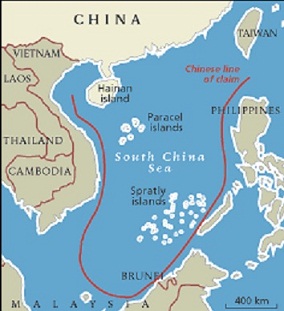
All you need is a look at the map to see the imperiousness and brazenness by which the red line was drawn across the blue space to mark the claimed territory. Pushing out as far as possible away from its own shores, it proceeds to graze right through its own neighbors’. Imagine this happening in your own locale, one of the neighbors, Mr. Big Shot, suddenly howling out to all that the entire lake where everyone in the community fishes and takes a swim, is all his, then proceeds building a fence cutting across everyone else’s front yard. Of course, you and the other neighbors would bristle and protest, because you know that you own part of the lake too. But then as he is the most powerful man in the block, you oppose him only at your own peril.
Anyway one sees it, it is not a pretty sight. It is a scandalously inconsiderate and arrogant. It is nothing but a brazen display of Might, where Might makes Right because anyone who would dare pose any challenge would be crushed helplessly. That is not an act of a good neighbor.
Now, that is just me with my layman’s rather simplistic view of the world. In the world of global relations and diplomacy, there are possibly other elements that my analogy could not capture. Like China’s competition with the world’s superpowers for world domination, for instance. Still and all, the principles and elements that build a good neighborhood are all and the same at every level. In an increasingly interconnected world, we are a community of nations, much a like a community of people who must learn to live with each other.
Is this the best way for China to guard its own dominion in this part of the world and advance its interest? Be rough and intimidating on its neighbors? Instead of employing persuasive powers, the terror of brute force? This is not the way to win allies nor sway enemies.
Now that the ruling on its nine-dash line was dashed by the International Tribunal, China decides to dig in and threatens the Philippines and the rest of the world to lay it aside or else. After ignoring the jurisdiction of the Tribunal where it could have presented its side with its own evidence, it now uses the international media to broadcast its side of the story while threatening the rest of the world of possible devastating consequences.
The world should engage the citizens of China. Do they agree to the actions of their government?
China should reconsider its own posture and image. As a mighty giant, it should not be seen as a bully or an intemperate ogre ready to go on a rampage if offended. It should assume a more high-minded stance as a world superpower. The Philippines indeed could be leaning more on its side being a next-door neighbor which could provide plenty of benefits, but is being pushed away instead into the embrace of another.
ON THE WAR AGAINST DRUGS
In the spirit of the times, for whatever it is worth, I am re-publishing a couple of posts about the war against drugs, the first from a year ago, the second, from eight.
1.Why the War on Drugs Will Never be Won
The case of Maryjane Veloso, the Filipina convicted of drug offense whose execution in Indonesia was temporarily stayed, once more calls attention to the wisdom— or lack of it— of the war against drugs. Maryjane is really just one among the so-many casualties of this war. Indeed, how many thousands have been executed or sentenced to a lifetime in jail since the war started? How much public funds have since been poured into the effort? Yet, illegal drugs trade has steadily flourished over time into a multi-billion dollar industry worldwide, and is growing more robustly than ever. This alone should compel us to rethink our approach and strategy.
Society, no doubt driven by noble motives, takes it to itself the responsibility to shield its citizens from the menace of drugs. Thus it legislates laws in various degrees of severity in the fulfillment of this assumed responsibility.
The drug user though does not share such society’s concern; he rebels against it. To him, it is simply his right, he exercising his own free will to satisfy his own cravings. It is not for society to decide what pleasures he must indulge in or not. At times, he must be perplexed: what’s the big deal? what wrong is there in his using drugs? He enjoys the highs and the mind-bending effect it has on himself, why deny it to him? It is not like he is causing any damage on anyone or anybody’s property that if caught he must be shot to death or be placed in prison for the rest of his life. If there be any harm, it is only on himself, but then that is his personal business. A lot much like smoking or drinking or skydiving… Absent any moral restraint or bother, there being no inherent evil in his vice, he continues to seek the fulfillment of his desires, plays cat and mouse with the police if need be, and pays the price no matter how high— and to hell with the Government playing Big Brother on his life.
Now, where there is a buyer, at the right price, there is always a seller, count on it. To the seller, it is simply business, no more no less. The merchandise to him is just that, a thing to sell for profit. Does a businessman care if his rope is intended for suicide? Or the knife to kill? Yet even in case he does and shifts to other wares to sell, trust that someone will emerge from out of nowhere to take his place to supply the buyer the merchandise, if under the most forbidding circumstances, at the right price.
The thing is, prohibition accomplishes two things: one. it limits general access of the public to the drug, but, two, it also jacks up the price of the merchandise. The first is the intended result, the second the unintended. From the original unintended consequence emerges a chain of undesirable spin-offs. As prohibition jacks up the price of the product, at times astronomically, peddling drugs becomes an extremely lucrative business. It’s the Law of Supply and Demand, nothing more. And because it is illegal, the criminal types naturally get to take full charge. The kind to whom you would otherwise deny access to riches for the evil that they are, inevitably they get to take control of a business that rakes in cash in overflowing abundance. What happens when criminal minds have billions at their disposal? Of course, limitless power to buy or force their way in and out of every nook and cranny of society. To what extent do they now have control of our society, we could only speculate. But if the occasional cocky display of power and hints of incipient influence be any guide, we could only shudder.
Indeed, it is a difficult dilemma but we must make a choice. Protecting society from the evils of drugs appears to have spawned a greater monster.
2. An Argument for the Legalization of Drugs
For alcohol prohibition, our US version, it was about 13 years. Between mafia crime, poisonings from adulterated beverages, and the dropping age at which people were becoming alcoholics, Americans decided that the “Noble Experiment” — whether it should actually be regarded as noble or not — was a bad idea. And they ended it. New York State did its part 75 years ago today, ratifying the 21st amendment to repeal the 18th amendment, bringing the Constitution one state closer to being restored. It took another half a year, until December 5th, to get the 36 states on the board that were needed at the time to get the job done. But Americans of the ’30s recognized the failure of the prohibition experiment, and they took action by enacting legalization of alcohol. Industrialist John D. Rockefeller described the evolution of his thinking that led to the recognition of prohibition’s failure, in a famous 1932 letter:
“When Prohibition was introduced, I hoped that it would be widely supported by public opinion and the day would soon come when the evil effects of alcohol would be recognized. I have slowly and reluctantly come to believe that this has not been the result. Instead, drinking has generally increased; the speakeasy has replaced the saloon; a vast army of lawbreakers has appeared; many of our best citizens have openly ignored Prohibition; respect for the law has been greatly lessened; and crime has increased to a level never seen before.”
The “experiment” with drugs, it appears anywhere you look, is headed for the same devastating failure. In the United States, the trend is going opposite the intended direction: addiction is worsening and the industry is flourishing. This despite the billions of dollars poured into the effort, not to mention thousand deaths and executions littering the path. And surprisingly, figures show higher percentage of users in countries where draconian measures are on employ, like the US.
To be clear, the above article comes from a pro-drugs site likely maintained by drug addicts. Yet, while the idea is unpopular, its pitch for legalization makes sense. For ultimately, the economics of the market will force the issue. Prohibition does not and cannot eliminate the twin forces of supply and demand. That much is clear, notwithstanding the nobility of the mission to shield people from the perceived evils of drugs. It can for a time stand in the way but like water seeking its own level the forces of supply and demand eventually adjust to find their equilibrium. Basic economics, pure and simple. Price goes up sky high to reflect the deadly risks involved in the equation. Indeed, the business maxim that risk and profitability are in direct proportion to each other, is just as true here. Which means a more dogged enforcement coupled with laws made more severe would only jack up the price of drugs even more. With a margin of profit two-arm lengths wide, you have an extremely lucrative business opportunity in your midst openly luring all sorts of risk-takers from far and wide, from high and low, from every nook and cranny to cash in quickly real big time. And as it is prohibited by law, business go nowhere but underground, naturally— into the hands of shady characters that very well belong there, people whose reason for being is to kill and die for every piece of action. Over time, wealth overflowing in limitless abundance accumulates in the wrong territory. You have a fountainhead of great power in the hands of Darth Vader. That which has had a humble start paying off and threatening lowly cops, moving gradually up, eventually graduates into bankrolling a presidential campaign. Then they take decisive control of society, these shady characters and their troops of gangsters, with a president as their front.
Follow closely how the P4B shabu haul in Subic will eventually disappear from view. It is instructive. Law enforcement finds its limits where this is said: “take this fortune and get out of the way or you and all the people you love will perish”. Show me one who will dare cross the line and I will show you a fool.
PRESIDENT DUTERTE
President Rodrigo Duterte starts his six-year term today. I wish him luck and good health, good health most especially because of his advanced age. I see a strong-willed, damn-all-the-torpedoes kind of leader with a clear—well, more or less— understanding of the nation’s problems. A natural-born leader, from what I sense, the role of leadership should fit him well, and, at 71, the oldest yet to become Philippine President, he should have the added advantage of the respect and deference normally accorded older people.
Despite all the flak he was getting lately for his roguish ways and wayward mouth, we are hearing enough admiring testimonies about the man from good, reputable people. He also has a remarkable track record to boot. These are enough for me for now. But just to be clear, I did not vote for him, well, not for anyone actually, because I skipped the elections altogether.
Let me make some cursory comments on a few things:
I think the China problem will be one of the most intractable and most difficult challenges. But maybe, just maybe–I laughed aloud when this idea came to me–his womanizing ways could actually help him navigate the waters. If you could balance between three to four women at a time, all of them happy to share between them you, maybe you too have the natural skill to deal with two world superpowers trying to woo you into their side. As it is, we are at a precarious balancing act between two powerful countries, and for the Philippines, the best position is to be able to stay in the middle, friendly in our own terms to both powerful nations, much like being the object of desire of two competing women who are taking care to be in your good favor. Huh, if Duterte could do that, it would be a great feat in diplomacy.
Poverty, this problem that has been with us for the longest time, should finally get its real solution. The designated NEDA chief, Dr. Ernesto Pernia, was talking about investment-led growth as the goal. Finally someone who understands… Most of poverty is actually due to lack of jobs or opportunity to earn enough means to pay for the high cost of living. So, it’s really all about job creation and job creation is a function of investment. More investment, more jobs; more jobs, less poverty. It’s an oversimplification in a way, but it helps to make plain one simple underlying science of it that is somehow often lost in too much theorizing and analysis.
I remember Duterte’s novel proposal about offering our numerous uninhabited or sparely populated islands as exclusive autonomous investment havens to big investors. I like the idea.
War on drugs? He will most likely fail in that area because it’s the law of supply and demand. Tighter drug prohibition would only serve to constrict supply and up the price of the commodity some more. The higher the price, the more profitable, though more risky, the business becomes. The more profitable the business goes, so do its size and wealth. Bigger and wealthier, more brute power and influence to battle the government. Like The Prohibition in the 1920s, it will only lead to more blood and violence in the streets but the industry would flourish nonetheless. The alcohol and cigarette of those years are the equivalent of our prohibited drugs today. The same social and economic forces are at work, no more, no less, and look at where alcohol and cigarettes are being sold today. But, hey, I am willing to be disproved.
President Duterte has taken personalities of varied, even opposing, persuasions into his Cabinet. I am wondering just by what magic could he meld such divergent personalities into one working team, instead of one squabbling bunch.
I am also amazed at how he is taking everybody into the fold: Joma Sison and the communists, Nur Misuari and the separatist Muslims, the human rights victims, leftist radicals, the Marcoses… wow!
There’s just so much in one plate: war on drugs, war on criminality, war against corruption, war against poverty, bureaucratic reform, economic reforms, peace talks with the communists, peace talks with the Muslim rebels, constitutional revision, parliamentary form of government, federalism, and more…
But Duterte should be wary of the Yellows. The Yellows genuinely believe that he was voted into office by a misguided, ignorant minority. They also believe that they are duty-bound to put things back in order by whatever means necessary. They are the ones who are happy about the way things are and are opposed to change. They are the ones agog over the developments over the last six years. They are the ones who want continuity and are against the disruption and reordering of things that Duterte had promised to make. Make no mistake about it, they are the enemies who are lying in wait for his fall…


 RICELANDER'S BLOG